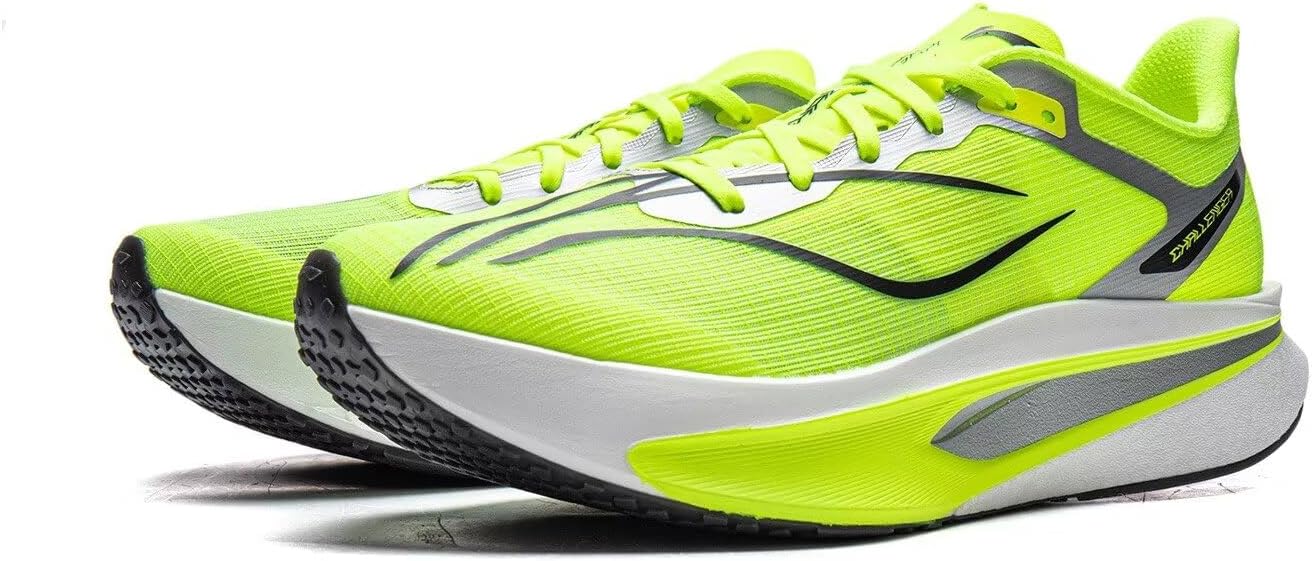
If you’ve heard runners talking about “carbon plate shoes,” here’s the quick version: a carbon-fiber plate is embedded inside the midsole (the cushioned layer between your foot and the ground) to store and return energy with each stride — think of it like a built-in spring. These shoes were once exclusively the domain of $250+ flagship models from Nike and ASICS. That’s changed. Chinese sportswear giant LI-NING — yes, the same brand that outfits Olympic athletes — now sells carbon race shoes in the $100–$140 range that reviewers are genuinely comparing to Saucony and Brooks’ best efforts. If you’re deciding where to put your next gear dollar, or you’re mid-rotation build and wondering whether one of these budget plates deserves a slot, this article is the decision frame you need. We’ll name the tradeoffs, show you what real owners report, and give you clear “if X, then Y” guidance at the end.
| EDITOR'S PICKNew Balance Men's FuelCell Supe… | Mid-tierSaucony Men's Endorphin Pro 4 S… | Budget pickNew Balance Men's FuelCell Supe… | |
|---|---|---|---|
| Colorways | Urgent Red/White/Black | Fog/Peel | Urgent Red/Sea Salt/Black |
| Size | 12 | 10 | 9 |
| Model Line | Supercomp Elite V5 | Endorphin Pro 4 | Supercomp Trainer V3 |
| Price | $178.10 | $138.09 | $127.25 |
| See on Amazon → | See on Amazon → | See on Amazon → |
The LI-NING Feidian 6 Elite: The Data-Rich Case for a Budget Plate
The most compelling story in this category right now belongs to the LI-NING Feidian 6 Elite. According to aggregated owner reviews compiled by RunRepeat, this shoe has generated an unusually high volume of structured feedback for a non-Western brand — and the signal is surprisingly consistent.
The hook worth leading with: one reviewer documented a 10K personal best in the Feidian 6 Elite while specifically noting that they have wide feet and that the New Balance SC Elite V3 in 2E (an already wide-fitting variant) still felt snug for them. That detail matters. Wide-foot runners are routinely squeezed out of carbon race shoes, and a verified PB from a reviewer in that exact situation is the kind of concrete data point that belongs in your decision matrix. A separate Feidian reviewer, also on RunRepeat, called it an “Endorphin Speed 4 Killer” for budget-conscious runners — high praise that directly positions it against a shoe with deep name recognition in the enthusiast community.
What’s driving that perception? Published specs put the Feidian 6 Elite in the same general midsole territory as mid-tier European and American plates: a full-length carbon plate, a PEBA-adjacent foam (LI-NING’s proprietary “䨻” compound, pronounced “beng”), and an outsole with at least partial carbon-rubber coverage for durability. For context, Podium Runner’s editorial overview of carbon plate shoe technology notes that PEBA-type foams — the same foam category used in Nike Vaporfly and ASICS Metaspeed — are what separates the genuine “supershoe” tier from EVA-based plated trainers. The Feidian 6 Elite uses foam from that higher tier. At its price point, that’s the structural reason reviewers keep reaching for the Endorphin Speed comparison.
By the numbers — Feidian 6 Elite vs. its nearest Western rivals:
| Shoe | Approx. Price | Plate Material | Foam Type | Heel Stack (approx.) |
|---|---|---|---|---|
| LI-NING Feidian 6 Elite | ~$120–$140 | Full carbon | PEBA-type (“beng”) | ~39mm |
| Saucony Endorphin Speed 5 | ~$160 | Nylon (TPEE) | PWRRUN PB | ~39mm |
| Saucony Endorphin Pro 4 | ~$200 | Full carbon | PWRRUN PB | ~39mm |
| Brooks Hyperion Elite 5 | ~$250 | Full carbon | DNA Flash v2 | ~38mm |
Specs drawn from manufacturer published data and Runners World spec comparisons; prices reflect U.S. retail as of May 2026.
Saucony’s Endorphin Line: The Benchmark You’re Actually Comparing Against
Before deciding whether a budget plate is “worth it,” you need a honest read on what the Western benchmark actually delivers. Saucony’s Endorphin family is the right reference point because it spans the exact price gap this article is about.
A reviewer on RunRepeat who described owning every generation of the Endorphin Speed line provided useful lineage context for the Endorphin Pro 4: the Pro 4 is described as “less bouncy than the Elite [Endorphin Speed] but fully satisfying at its price” — a distinction that tells you something important. The Pro 4 uses a full carbon plate (versus the Speed 5’s nylon plate) and produces a more planted, propulsive ride rather than the more trampoline-like sensation of a nylon plate. Runners World’s review coverage of the Endorphin Speed line consistently describes the Speed 5 as the better daily-training-to-workout bridge, while the Pro 4 is the cleaner race-day tool.
The decision frame here: if you’re building a rotation where one shoe serves both tempo work and B-race duty, the Endorphin Speed 5’s nylon plate is more forgiving across volume. If you want a dedicated race-day weapon and your budget cap is $200, the Pro 4 earns its slot. The Feidian 6 Elite, sitting at $80–$100 less than the Pro 4, is genuinely competing in the same conversation — the difference being that you’re accepting reduced Western retail support, less return-policy certainty, and a narrower community of owners to compare notes with.
Brooks Hyperion Elite 5: A Split Verdict You Should Weigh Carefully
The Brooks Hyperion Elite 5 is the kind of shoe that generates strong opinions in both directions, and the review pattern at RunRepeat reflects exactly that.
Competitive runners report dramatic time improvements — multiple reviewers cite going 30 to 45 seconds per mile faster compared to their previous training shoes. That range is consistent with what Outside Online’s carbon plate buyer’s guide describes as the upper bound of energy-return benefit for trained runners running at sub-8:00 pace. That performance signal is real.
But then there’s the other side of the data. A wide-foot runner reported that the Hyperion Elite 5’s narrow heel made the shoe functionally unusable — not “slightly uncomfortable,” unusable. For wide-foot runners, this is a disqualifying flag that deserves to be right at the front of your decision, not buried in the fine print. Additionally, a 1-star review describes cheaply made plastic mesh uppers and damaged packaging upon arrival — a quality-control complaint, not a performance one, but worth noting at a $250 price point where the expectation of build quality is baked into the ask.
The honest summary on the Hyperion Elite 5: if your foot fits the last (standard to slightly narrow), the performance data is compelling enough to take seriously. If you have wide feet, skip it and go back to the Feidian 6 Elite data above.
A Caution Flag: The ASICS METASPEED Sky Tokyo Has Too Little Review Data
The ASICS METASPEED Sky Tokyo deserves a mention because it keeps appearing in “best carbon shoes” lists — but it comes with an important caveat. As of May 2026, the Sky Tokyo has a very thin review footprint. The pattern that does exist skews heavily toward 5-star ratings, with one notable 2-star review describing the buyer as “disappointed.” That’s not enough signal to form a confident recommendation.
What the polarization pattern usually indicates in aggregated shoe reviews: a shoe with a very specific fit or geometry that either matches your foot perfectly or doesn’t at all, with no middle ground. Given that the standard METASPEED Sky+ (the prior generation, not the Tokyo variant) is one of the most reviewed and validated carbon shoes on the market — with Podium Runner and Runners World both giving it strong marks — the Tokyo variant may simply be too new and too limited in distribution to have accumulated trustworthy feedback. If you’re specifically targeting the Tokyo model, wait for more data. If you want ASICS carbon performance now, the Metaspeed Sky+ has the review depth to support a purchase decision.
Frequently Asked Questions
1. Are LI-NING running shoes actually competitive with Saucony and ASICS at the same price?
Based on the available review data, yes — with important caveats. The LI-NING Feidian 6 Elite uses foam technology (PEBA-type “beng” compound) that competes in the same category as the foams in Western supershoes, which is the primary performance driver in this shoe class. Reviewers have documented PRs and directly compared it favorably to the Saucony Endorphin Speed line. Where LI-NING falls behind is in fit data breadth (fewer Western owners means less diverse feedback), retail return infrastructure, and brand community support. The performance case is legitimate; the purchase-experience risk is slightly higher.
2. What is the difference between a carbon plate race shoe and a plated trainer?
A carbon plate race shoe (also called a “supershoe”) uses a full-length carbon-fiber plate paired with a PEBA-type foam that is engineered to compress and rebound efficiently at race intensities. The geometry is typically aggressive — high heel-to-toe drop in some cases, rocker-shaped outsole — and the foam degrades relatively quickly, typically in the 200–400 mile range. A plated trainer uses a stiffer nylon or partial plate in a more durable, higher-volume foam. The Saucony Endorphin Speed 5 is a plated trainer. It can handle 500+ miles and works for tempo runs. As Outside Online’s carbon plate guide notes, the distinction matters most for your training plan: rotating a carbon race shoe into daily training eats the shoe’s lifespan faster than most runners expect.
3. Do I need to run a certain pace to benefit from a carbon plate shoe?
The short answer is no, but pace affects the magnitude of benefit. The energy-return mechanism works regardless of pace — the plate stores energy at footstrike and releases it at toe-off. However, multiple studies cited in Podium Runner’s carbon shoe technology overview indicate that the measurable economy gains are larger at faster paces (roughly sub-8:30/mile and faster), where the foam is compressing more fully with each stride. Slower runners still get a real benefit, particularly from the rocker geometry reducing calf and ankle fatigue late in a race. It’s not a shoe that “locks you out” at any pace — it’s a shoe where faster runners feel a proportionally bigger return on the investment.
4. How do the Saucony Endorphin Pro 4 and Endorphin Speed 5 differ for race day vs. training?
The Pro 4’s full carbon plate produces a more propulsive, locked-in sensation ideal for race day but feels stiffer in easy-pace runs, making it a poor choice for regular training. The Speed 5’s TPEE nylon plate is more compliant and versatile — reviewers describe it as smooth enough to use for long runs and tempo work without excessive fatigue. For a simplified recommendation: if you’re racing a half or full marathon and have budget for one dedicated shoe, the Pro 4. If you need one shoe to cover workouts, tune-up races, and your A-race, the Speed 5 handles the range better.
5. Are wide-foot runners excluded from most carbon plate race shoes?
Effectively, yes — with a few exceptions. The wide-foot runner who documented a 10K PB in the LI-NING Feidian 6 Elite (and noted that even the NB SC Elite V3 in 2E felt snug) is the most striking counterexample in the current review data. The Brooks Hyperion Elite 5 has been flagged as a problem fit for wide feet, specifically in the heel. Most carbon race shoes run narrow to maintain plate geometry and reduce upper weight. If you’re shopping wide, the Feidian 6 Elite’s reported fit is the strongest current data point you have. New Balance’s SC Elite V3 2E is the other name that consistently appears in wide-foot-friendly carbon discussions, though the SC Elite line’s stack and geometry differ meaningfully from the Feidian.
The Decision Rule
Here’s the if/then frame this article has been building toward:
If your feet are standard to narrow width and your budget is $200+: The Saucony Endorphin Pro 4 or Brooks Hyperion Elite 5 are the validated Western options. Know that the Hyperion has a narrow heel and inconsistent QC reports — factor that in.
If your budget is under $160 and you want plated performance across training and racing: The Saucony Endorphin Speed 5 is the most versatile single-shoe option in the space, with deep review history backing it.
If you have wide feet and want a legitimate carbon race shoe: The LI-NING Feidian 6 Elite is currently the most documented wide-foot-friendly option in the budget plate category. The PB data is from a real wide-foot owner, not a marketing brief.
If you’re looking at the ASICS METASPEED Sky Tokyo specifically: Wait. The review data is too thin and too polarized to make a confident call right now.
The LI-NING question at the center of this article deserves a direct answer: the evidence is good enough that dismissing the Feidian 6 Elite because of brand unfamiliarity would be leaving genuine performance on the table. The risk isn’t the technology — it’s the purchase logistics. If you can live with that tradeoff, the data supports the buy.