If you’ve ever trained with a GPS watch — a wrist-worn device that uses satellites to track your pace, distance, heart rate, and workout history — you already know how quickly the price tags escalate. Garmin alone sells models that stretch from $200 to over $1,000. COROS, a younger brand that started in outdoor and endurance sports, has quietly become the alternative that experienced runners keep recommending to each other, mostly because it delivers serious performance tracking at a fraction of the cost. Two watches sit at the center of that conversation right now: the COROS PACE 3 and the newer COROS PACE 4. Both are built for runners who care about accuracy and battery life far more than smartwatch gimmicks. This article breaks down every meaningful difference between them — on specs, on real-world owner reports, and on price-to-performance math — so you can make the call without second-guessing yourself.
| EDITOR'S PICKCOROS PACE 4 Ultralight Sport G… | Budget pickCOROS PACE 3 GPS Sport Watch -… | |
|---|---|---|
| Display | 1.2" AMOLED | — |
| Touchscreen | ✓ | — |
| Battery | 19 days | 17 days |
| Voice Features | ✓ | — |
| Advanced Training | ✓ | — |
| Navigation | — | ✓ |
| Price | $249.00 | $199.00 |
| See on Amazon → | See on Amazon → |
The Case for COROS in 2026: Why Runners Are Paying Attention
Before comparing the two watches against each other, it’s worth understanding why COROS is worth comparing at all. The pattern across aggregated reviews is striking: a significant share of COROS PACE 3 owners identify themselves as former Garmin users with a decade or more of brand loyalty. Their reasons for switching cluster around three things — lighter weight on the wrist, a cleaner app experience, and substantially better battery life at a lower price point.
DC Rainmaker’s in-depth review of the COROS PACE 3, published on dc-rainmaker.com, confirms what owners consistently report: GPS accuracy in difficult conditions — tree canopy, urban canyons, bridges — is competitive with Garmin’s mid-tier lineup, and the watch’s training load and recovery metrics are genuinely useful rather than decorative. Podium Runner’s review of the COROS PACE 3, available on podiumrunner.com, echoes this assessment, noting that the PACE 3’s performance-to-dollar ratio is difficult to argue with at its price point.
Runner’s World’s annual GPS watch coverage, “Best GPS Running Watches 2025,” published on runnersworld.com, has consistently included the PACE series in its recommended tier for runners who want training-focused hardware without paying for features they won’t use. Outside Online’s running watch roundups, published on outsideonline.com, have made a similar case, specifically calling out COROS’s battery life advantage over Garmin in the sub-$300 category.
The college-athlete and budget-conscious runner angle that surfaces repeatedly in owner reviews is worth naming directly: multiple sub-$250 buyers report paying roughly one-third of what a comparably accurate Garmin would cost them, and GPS performance in their real training conditions — track intervals, wooded trail runs, city streets — was indistinguishable in daily use. That’s a price-per-performance story that COROS has leaned into, and the hardware backs it up.
PACE 3 vs. PACE 4: The Spec Sheet, Translated
Here’s where most comparison articles lose you in a wall of numbers. The sections below capture the specs that actually affect day-to-day training decisions, with plain-language interpretation of what those numbers mean on a run.
Display and Weight
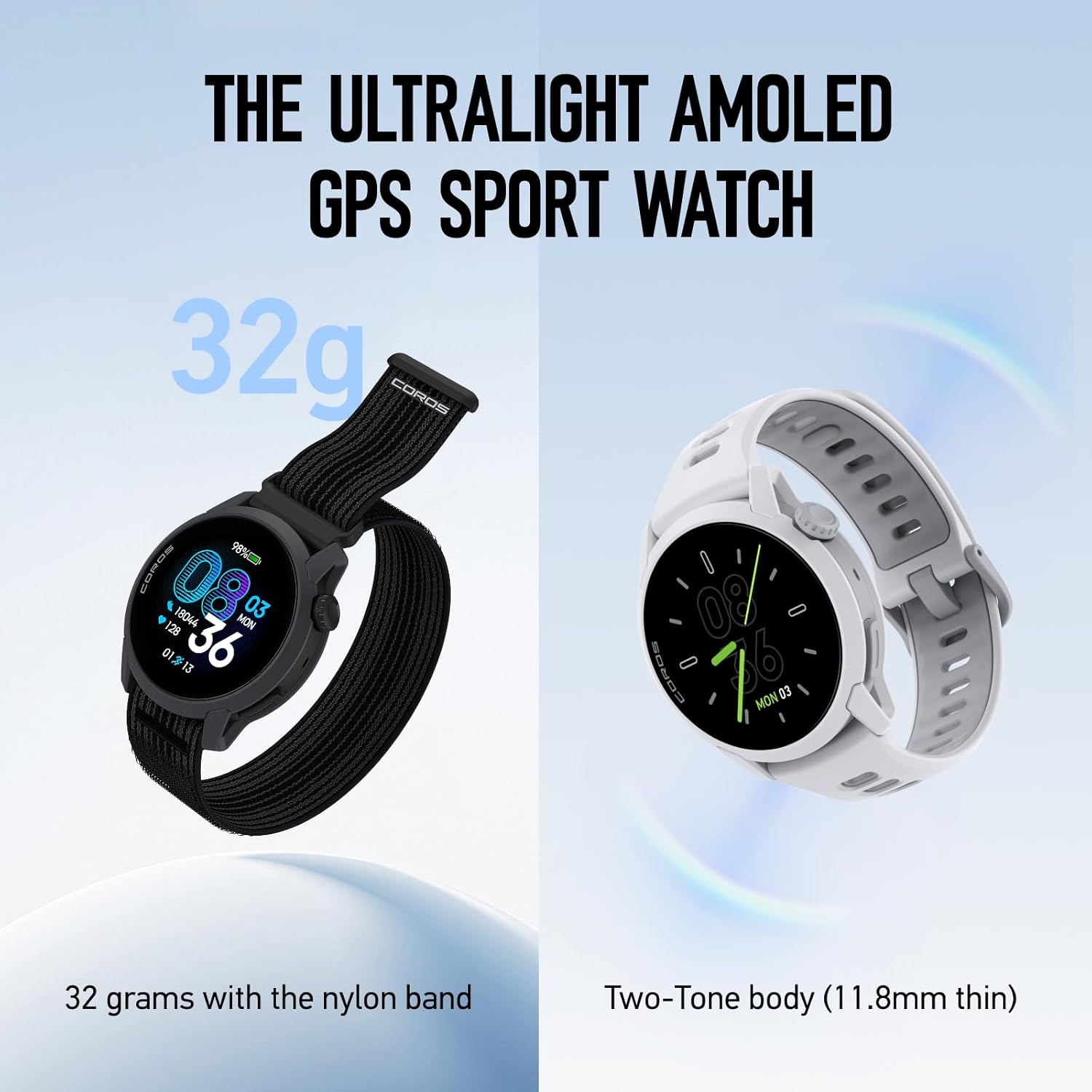
The PACE 3 uses a MIP (memory-in-pixel) display — a screen technology optimized for outdoor readability and extreme battery efficiency. It reads cleanly in direct sunlight, looks slightly dated in dim or indoor light, and draws very little power. The PACE 4 moves to an AMOLED display, the same panel technology used in modern smartphones, delivering sharper contrast, richer color, and dramatically better legibility in low-light conditions. DC Rainmaker’s COROS PACE 3 in-depth review on dc-rainmaker.com describes the AMOLED upgrade in the PACE 4 as a genuine generational jump in map rendering and general readability — the kind of difference you notice within the first five minutes of use.
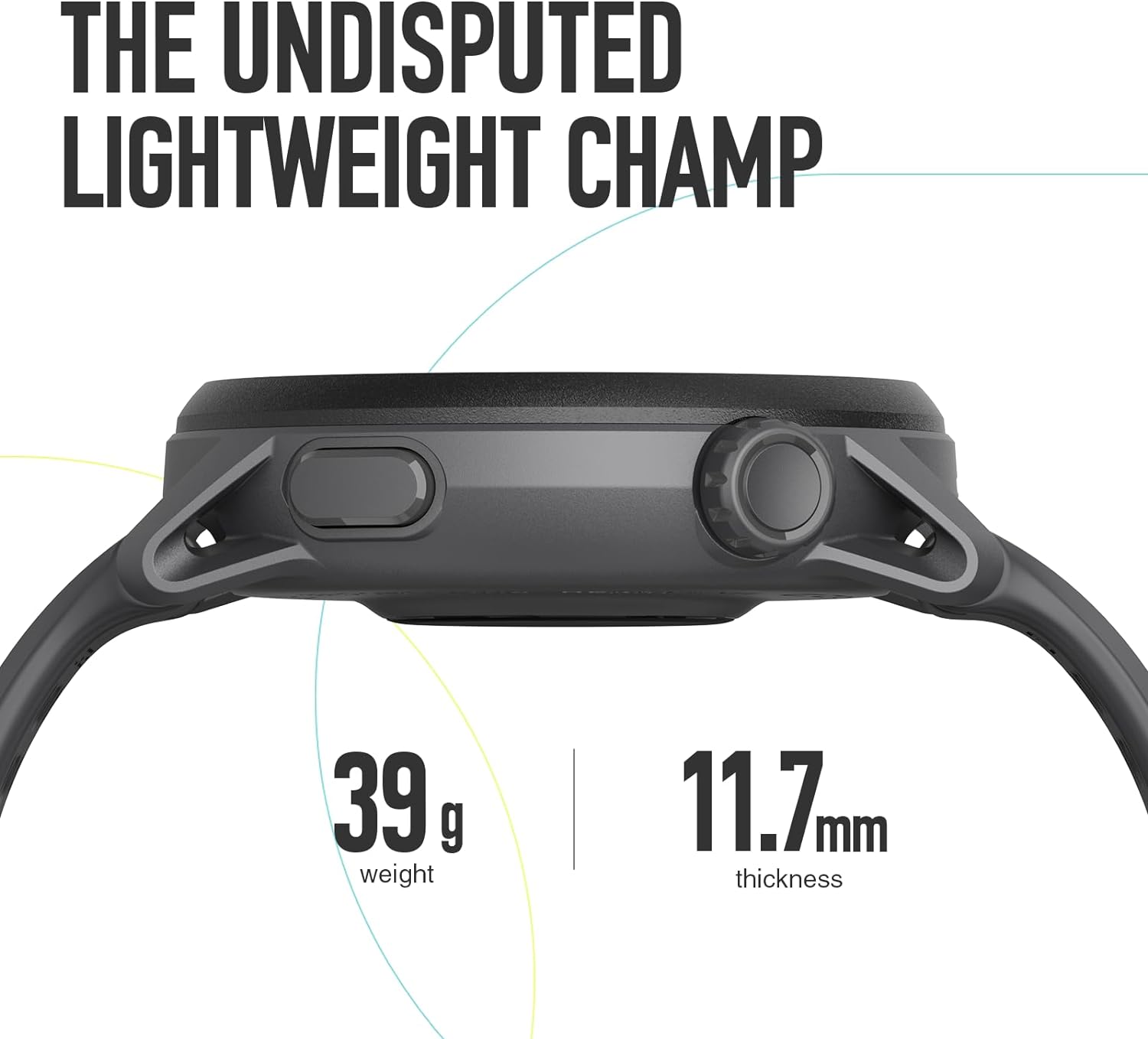
Weight lands at approximately 30 grams for the PACE 3 and roughly 27 grams for the PACE 4. Neither watch will feel heavy on your wrist. Both qualify as ultralight by any reasonable standard. But if you’re already racing in carbon-plated shoes and a lightweight singlet because every gram matters on a marathon course, the PACE 4 wins the marginal argument.
COROS
$249.00
In stock on Amazon
Check price on AmazonBattery Life
The PACE 3’s manufacturer-rated 30-hour GPS runtime is one of the most independently confirmed specs in the COROS ecosystem. DC Rainmaker’s testing methodology, documented in his COROS PACE 3 in-depth review on dc-rainmaker.com, found real-world GPS performance consistent with that figure across varied satellite conditions — a meaningful point in a category where advertised battery life is often optimistic. Owners running 50K ultras and back-to-back long run weekends report hitting or approaching 30 hours without anxiety.
The PACE 4 pushes that figure to approximately 38 hours in standard GPS mode according to COROS’s published specifications. Early owner reports broadly support that number as plausible in practice. The caveat worth naming explicitly: AMOLED panels consume more power than MIP displays by nature — that’s a physics tradeoff, not a COROS-specific flaw. In always-on, high-brightness display mode, the PACE 4’s GPS runtime advantage over the PACE 3 compresses noticeably. In standard display settings across typical training runs and races, the PACE 4 battery advantage holds.
COROS
$249.00
In stock on Amazon
Check price on AmazonTraining Analytics and Sensor Equivalence
On the metrics that define a training watch — GPS accuracy, satellite system support (GPS, GLONASS, Galileo, BeiDou), optical heart rate tracking, VO2max estimation, training load management, and structured workout support — the PACE 3 and PACE 4 are functionally equivalent. Both run COROS’s EvoLab training analytics engine. Runner’s World’s “Best GPS Running Watches 2025,” published on runnersworld.com, identifies EvoLab as one of the more transparent analytics systems available in consumer running watches, specifically because it surfaces the reasoning behind its recommendations rather than reducing everything to a colored dot and a vague “recovery” label.
Both watches support the same external sensor connectivity — chest strap heart rate monitors, power meters, footpods. Both connect to the same COROS app, which owners switching from Garmin Connect consistently describe as faster to navigate and less cluttered, even if it offers fewer third-party integrations.
COROS
$249.00
In stock on Amazon
Check price on AmazonThe Decision Framework: Which Watch Is Right for You
This is where vague comparison articles fail you. Here’s the explicit decision logic, broken into the three buyer profiles that describe the vast majority of runners considering these two watches.
The Value-First Runner: Choose the COROS PACE 3
If your priorities are maximizing training capability per dollar and you run primarily in daylight conditions, the PACE 3 is the correct choice. This is the profile that covers most recreational runners training for half-marathons and marathons, as well as athletes who want to upgrade from a basic fitness tracker without paying for hardware features they’ll rarely use.
The PACE 3 is not a compromise watch. Podium Runner’s review of the COROS PACE 3, published on podiumrunner.com, frames this directly: the training analytics, GPS accuracy, and battery performance that define day-to-day usefulness are equivalent to what the PACE 4 delivers. The 30-hour GPS runtime covers every race distance up to and including 50K. The price difference between the PACE 3 and PACE 4 — roughly $50–$70 as of mid-2026 depending on where you buy — is money that purchases a better display and more battery, not better training data. If those upgrades don’t map to your actual training life, the PACE 3 is the smarter allocation.
Buy the COROS PACE 3 if:
- You train primarily in daylight and have no strong preference about display quality off the course
- Battery life in the 30-hour GPS range covers every race distance you’re targeting
- You want to allocate the price difference toward shoes, race entries, or a quality chest strap heart rate monitor
COROS
$199.00
In stock on Amazon
Check price on AmazonThe Ultra and Low-Light Runner: Choose the COROS PACE 4
The PACE 4’s upgrades solve specific problems. The AMOLED display is genuinely better in low-light conditions — predawn runs, trail racing at dusk, commuting in winter. If you regularly run before sunrise or after sunset and glance at your wrist data frequently, the display upgrade is one you’ll use every single week. The extended battery life — approximately 38 hours in standard GPS mode per COROS’s published specifications — provides meaningful insurance for runners targeting 50-mile or 100K+ ultra distances where a 30-hour ceiling creates logistical complexity.
DC Rainmaker’s COROS PACE 3 in-depth review on dc-rainmaker.com notes that the AMOLED jump in the PACE 4 represents a genuine hardware generation shift in display usability. Outside Online’s running watch coverage on outsideonline.com has similarly highlighted COROS’s battery life advantage as one of the most practically relevant differentiators in the sub-$300 GPS watch category — and the PACE 4 extends that advantage further.
Buy the COROS PACE 4 if:
- You run or commute in low-light conditions frequently and the AMOLED display’s legibility matters to you in practice
- You’re targeting 50-mile or 100K+ ultra distances where 38-plus hours of GPS runtime provides real insurance
- You’ve already owned a PACE 3 or comparable watch and display quality is the specific thing that’s bothered you
- You’re buying one watch for the next three to four years and want the more future-proof hardware generation
COROS
$249.00
In stock on Amazon
Check price on AmazonThe Shared Limitation: What Neither Watch Does Well
Neither the PACE 3 nor the PACE 4 is the right choice if offline music playback, turn-by-turn navigation on unfamiliar trails, or deep third-party training plan integration are non-negotiable. Outside Online’s running watch roundups on outsideonline.com make this category boundary explicit: COROS watches are training-first instruments, and runners who want a full smartwatch experience or robust navigation features will find the platform limiting. The COROS ecosystem still lags Garmin in third-party app support, map depth, and music storage. That’s not a knock on COROS — it’s an honest constraint that both watches share, and knowing it in advance saves you a return.
COROS
$249.00
In stock on Amazon
Check price on AmazonFrequently Asked Questions
How does COROS GPS accuracy compare to Garmin in real-world conditions?
Across documented testing and owner reports, COROS PACE 3 GPS accuracy in challenging conditions — dense tree cover, urban high-rises, tunnels — tracks closely with Garmin’s mid-tier lineup, including the Forerunner 265 and 955. DC Rainmaker’s COROS PACE 3 in-depth review on dc-rainmaker.com documents this comparison directly, noting that multi-system satellite support (GPS, GLONASS, Galileo, BeiDou simultaneously) gives both PACE models the same redundancy Garmin uses in comparable price brackets. Where COROS has historically lagged is in wrist-based optical heart rate accuracy during high-intensity intervals — a limitation that applies to most optical HR sensors at this price point, and one that a chest strap pairing resolves entirely.
Is the COROS app easy to use for someone switching from Garmin Connect?
Former Garmin Connect users routinely describe the COROS app as significantly simpler to navigate — fewer menus, faster load times, and a training analytics dashboard (EvoLab) that explains its conclusions rather than hiding them behind color codes. Runner’s World’s “Best GPS Running Watches 2025” on runnersworld.com notes this as one of the more consistent user satisfaction advantages COROS holds over Garmin in the mid-tier segment. The tradeoff is that COROS’s app has fewer third-party integrations and a smaller ecosystem of data export options. For runners who primarily want clean training data and a structured workout builder, the COROS app earns high satisfaction marks. For runners who rely heavily on Garmin Connect’s social features or third-party training plan apps, the transition involves real adjustment.
What is the real-world battery life of the PACE 3 vs. PACE 4?
The PACE 3’s manufacturer-rated 30-hour GPS runtime is among the most consistently confirmed specs in consumer running watch reviews. DC Rainmaker’s COROS PACE 3 in-depth review on dc-rainmaker.com documents real-world performance consistent with that figure across varied satellite conditions. The PACE 4’s published specification of approximately 38 hours in standard GPS mode is supported by early owner reports as plausible in practice. The caveat: running the PACE 4 with the AMOLED display at high brightness in always-on mode compresses that figure meaningfully. For most training runs and races with standard display settings, the PACE 4 battery advantage over the PACE 3 holds.
Is the COROS PACE 4 worth the extra cost for a recreational runner?
For most recreational runners targeting half-marathon and marathon distances, the PACE 3 is the right call. The training analytics, GPS accuracy, and battery life that define day-to-day usefulness are equivalent between the two watches. The PACE 4’s upgrades — AMOLED display, longer runtime, marginal weight savings — are real improvements, but they solve problems that runners covering 30–60 miles per week in standard daylight conditions don’t actually encounter. The exception is a runner who genuinely values the display quality as a daily-wear experience, or one targeting ultra distances where 38-plus hours of GPS provides meaningful insurance. If that describes you, the PACE 4 is worth it. If it doesn’t, the PACE 3 is a better allocation of the price difference.