Entry-Level GPS Watches Compared: Garmin Forerunner 55 vs. 165 vs. COROS PACE 3
If you’ve been timing your runs with a phone in your hand or a basic fitness tracker on your wrist, a dedicated GPS running watch is a genuine game-changer. GPS (Global Positioning System) watches lock onto satellites to track your exact pace, distance, and route without needing your phone nearby — and the running-specific models add heart rate monitoring, training load analysis, and structured workout guidance on top of that. The question isn’t really whether to get one. It’s which one makes sense for where you are right now and where you’re headed.
This comparison zeroes in on three watches that come up constantly in first-GPS-watch conversations: the Garmin Forerunner 55, the Garmin Forerunner 165, and the COROS PACE 3. All three sit in the entry-to-mid tier price range (roughly $200–$260 at 2026 retail). All three will handle half-marathon and marathon training without breaking a sweat. But they make meaningfully different tradeoffs — and once you see the decision frame clearly, picking the right one takes about five minutes.
| EDITOR'S PICKCOROS PACE 3 GPS Sport Watch -… | Mid-tierGarmin Forerunner 55 | Budget pickGarmin Forerunner 165 | |
|---|---|---|---|
| Battery Life | 17-Day | 2 Weeks | — |
| Display Type | — | — | AMOLED |
| Suggested Workouts | — | ✓ | — |
| Navigation | ✓ | — | — |
| Price | $199.00 | $149.99 | $129.00 |
| See on Amazon → | See on Amazon → | See on Amazon → |
What You’re Actually Comparing
Before diving into specs, it helps to name the four axes that actually separate these watches in day-to-day use:
- Screen technology — transflective MIP (readable in sunlight, battery-efficient) vs. AMOLED (vivid, always-on capable, power-hungry)
- GPS accuracy — single-band vs. dual-frequency (multiband), which matters most in urban canyons and under tree canopy
- Battery life — how many days between charges in GPS-on mode
- Platform ecosystem — Garmin Connect vs. the COROS app, and how each handles training analytics
Let’s run them side by side.
By the Numbers
| Forerunner 55 | Forerunner 165 | COROS PACE 3 | |
|---|---|---|---|
| Retail (2026) | ~$200 | ~$260 | ~$229 |
| Screen | MIP transflective | AMOLED | MIP transflective |
| GPS battery | 20 hrs | 19 hrs | 38 hrs |
| Smartwatch battery | Up to 14 days | Up to 11 days | Up to 17 days |
| Dual-frequency GPS | No | No | Yes |
| Weight | 42 g | 39 g | 30 g |
Head-to-Head: The Three Contenders
Garmin Forerunner 55: The Honest Workhorse
Garmin
$129.00
In stock on Amazon
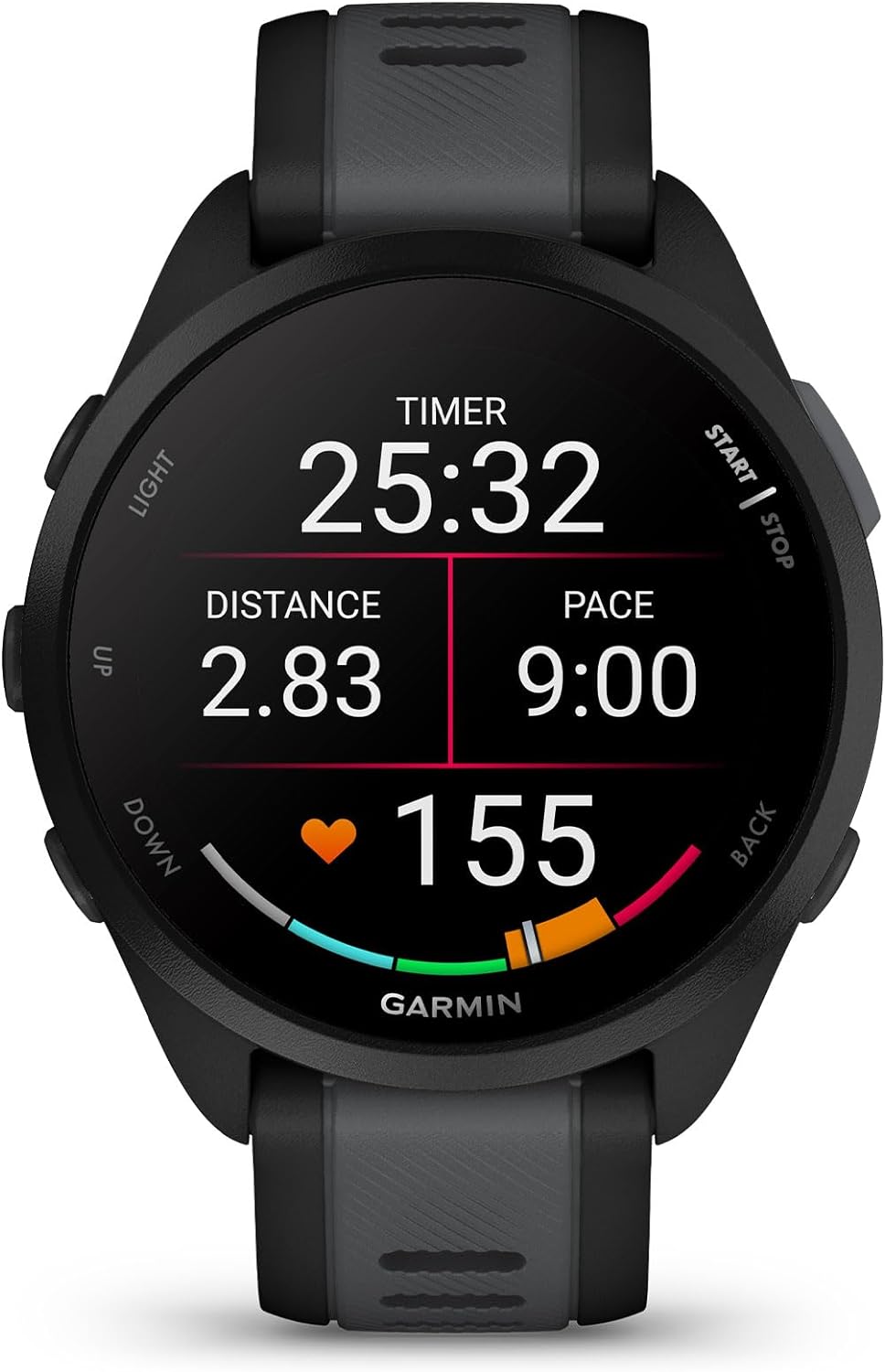
Check price on AmazonThe Forerunner 55 is the watch Garmin built for someone who wants all the core running metrics — heart rate, pace, distance, altitude, VO2max estimate — without any decision paralysis. It delivers exactly that.
DC Rainmaker’s Garmin Forerunner 55 In-Depth Review notes that Garmin hit the brief cleanly: this is a no-frills GPS watch that does its main job reliably. Runners coming from Polar or Fitbit devices frequently describe the Forerunner 55 as a genuine upgrade, particularly for structured training metrics and the depth of the Garmin Connect app ecosystem.
Where it earns its keep: The 20-hour GPS battery is more than enough for marathon training blocks. The MIP screen is genuinely easy to read mid-run in direct sunlight, which AMOLED screens can struggle with depending on angle and brightness settings. And the two-week smartwatch battery means most runners will charge it once on a Sunday and forget about it until the following weekend.
The honest tradeoffs: No dual-frequency GPS. In a wide-open park this is essentially irrelevant. In a downtown corridor with tall buildings or on a trail with dense canopy, single-band GPS can drift — you might see a pace spike or a slightly short distance read on a measured course. It’s not a dealbreaker for most training, but it’s worth knowing. There’s also a practical sizing issue worth taking seriously: the 42mm, 42g case reads large on smaller wrists. If you typically run around a 6.5-inch wrist circumference or under, try it on before committing.
The Forerunner 55 is Garmin’s on-ramp. It covers everything the average runner needs — and that framing is accurate without being dismissive. If your priority is reliable data, proven software, and the lowest barrier to entry in the Garmin ecosystem, this is the pick.
Garmin
$129.00
In stock on Amazon
Check price on AmazonGarmin Forerunner 165: The AMOLED Upgrade Argument
Garmin
$149.99
In stock on Amazon
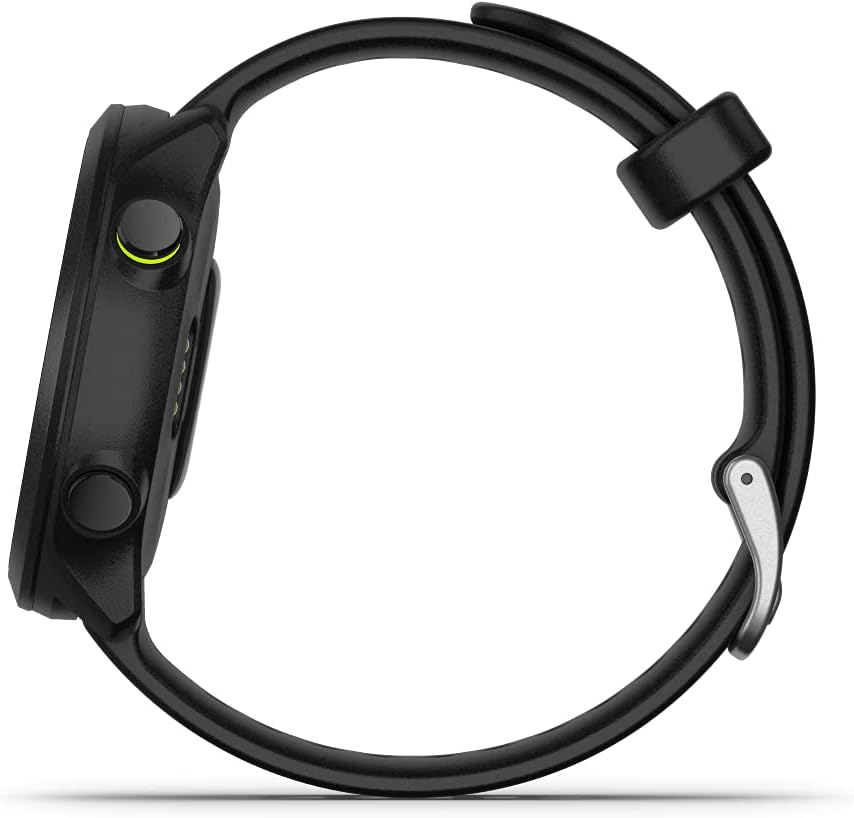
Check price on AmazonThe Forerunner 165 costs roughly $60 more than the 55. Almost all of that premium goes to one thing: the AMOLED display. AMOLED (Active Matrix Organic Light-Emitting Diode) means each pixel generates its own light — resulting in deeper blacks, significantly higher brightness ceiling, and a screen that looks closer to a smartphone than a traditional sports watch. Garmin’s implementation here is sharp. Runner’s World’s Garmin Forerunner 165 Review specifically calls out the display quality as a meaningful step up in everyday usability, noting it as one of the watch’s clearest selling points for runners who wear their GPS watch all day.
But here’s the honest math on AMOLED versus battery life: the screen is the primary reason the Forerunner 165’s smartwatch battery sits at approximately 11 days compared to the 55’s 14 days — and that’s with the always-on display disabled. If you leave Bluetooth phone notifications active, real-world use tends to land toward the lower end of that range. One actionable tip that surfaces consistently among 165 owners: turn off phone notifications, and you can reliably push daily battery life toward approximately 13 days. That’s not buried in the manual — it’s the kind of thing you learn from someone who’s been using the watch for three months.
GPS battery is roughly comparable to the 55 at 19 hours. Like the 55, the 165 uses single-band GPS — no dual-frequency. So if GPS accuracy in complex environments is a priority, neither Forerunner is the answer at this price tier.
Where the 165 wins: The screen makes data genuinely easier to read at a glance, particularly in lower light — early morning runs, winter training, indoor treadmill sessions where ambient light is controlled. The watch is also slightly lighter than the 55 at 39g versus 42g, and the case proportions read a touch cleaner on smaller wrists, though it’s a subtle difference. The Garmin Connect ecosystem is identical between the two models, so training analytics, workout builder, and plan syncing carry over perfectly.
The verdict on the $60 premium: If you use your watch as a daily wearable and care about the experience of glancing at your wrist throughout the day, the AMOLED display earns its cost. If you primarily care about the running metrics and charge your watch on a predictable schedule, the 55 is the smarter spend.
Garmin
$149.99
In stock on Amazon
Check price on AmazonCOROS PACE 3: The Challenger Worth Taking Seriously
COROS
$199.00
In stock on Amazon
Check price on AmazonThe COROS PACE 3 is the watch that runners who’ve spent years in the Garmin ecosystem are quietly switching to — and the reasons are specific enough to be credible rather than trendy.
The headline spec that separates the PACE 3 from both Forerunners at this price point is dual-frequency GPS (also called multiband GPS). This means the watch receives signals on two different frequency bands simultaneously, dramatically improving positional accuracy in environments where satellite signals bounce off buildings or get interrupted by tree cover. DC Rainmaker’s COROS PACE 3 In-Depth Review identifies this as a genuine differentiator — multiband GPS at sub-$250 retail is legitimately unusual, and runners who care about GPS fidelity notice it in their training data. DC Rainmaker’s review benchmarks the PACE 3 favorably against more expensive options specifically on GPS accuracy in challenging environments.
The other number that stops people in their tracks: 38-hour GPS battery life. That’s nearly double the Forerunner 55 and Forerunner 165. For marathon runners, this is largely academic — you won’t be out there for 38 hours. But for anyone training for ultras or longer trail events, this changes the calculus entirely. In smartwatch mode, the 17-day battery life sits comfortably above both Forerunners.
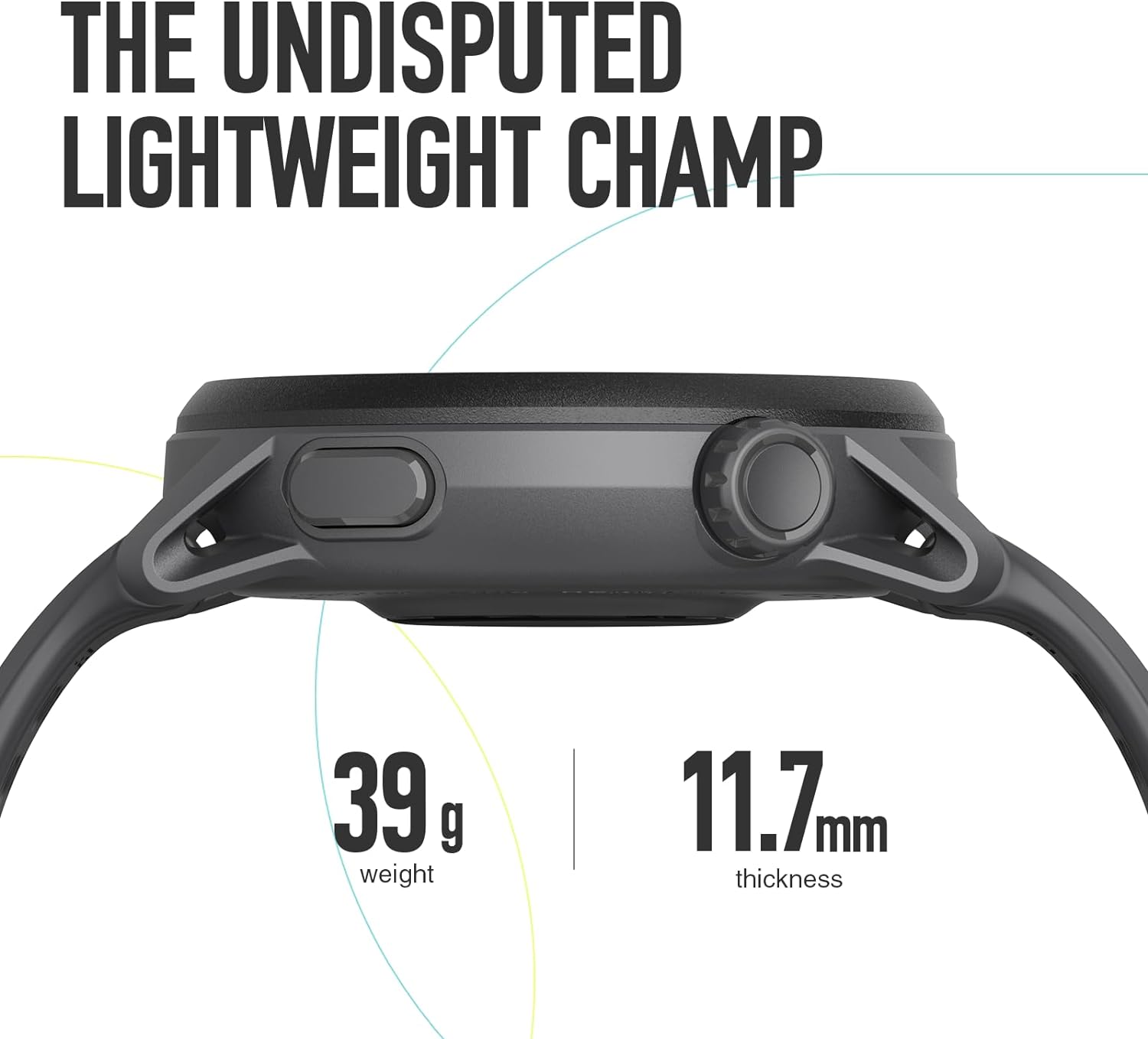
Then there’s the weight: 30 grams. The PACE 3 is legitimately light. Runners switching from Garmin frequently cite the lower weight as one of the tipping points alongside the cleaner app interface and the dual-frequency GPS. For competitive runners on tighter budgets — college athletes, in particular — the value-per-dollar ratio at this price point is hard to match among multiband-capable watches.
Where COROS makes you think twice: The COROS app ecosystem is genuinely good — clean interface, solid training load data — but it’s newer and has a smaller third-party integration footprint than Garmin Connect, which has had years to build connections with TrainingPeaks, Strava, and coaching platforms. If your coach or training plan is deeply embedded in the Garmin ecosystem, the switching friction is real. Podium Runner’s coverage of the best GPS running watches places the PACE 3 firmly in the conversation for runners who prioritize hardware value per dollar, while acknowledging that ecosystem maturity still favors Garmin for athletes with established platform dependencies.
COROS
$199.00
In stock on Amazon
Check price on AmazonFrequently Asked Questions
Does the Forerunner 55 have enough features for half-marathon training? Yes, comfortably. The 55 tracks pace, heart rate, distance, altitude, VO2max estimates, and structured workouts. The watch handles everything from easy zone 2 days to tempo intervals without issue, and runners who use it through full marathon training cycles consistently report no meaningful gaps in the data they needed.
Is the AMOLED screen on the Forerunner 165 worth the extra cost over the 55? It depends on how you use the watch. If you wear it all day and value the experience of glancing at a vivid, smartphone-quality display, Runner’s World’s Forerunner 165 Review describes the screen upgrade as a meaningful quality-of-life improvement. If you only care about in-run metrics and charge on a schedule, the 55’s MIP screen is perfectly functional and saves you $60.
How much does turning off notifications really extend battery life on the Forerunner 165? Meaningfully. The official spec is up to 11 days in smartwatch mode, but disabling Bluetooth phone notifications pushes practical daily use closer to 13 days for many owners. It’s not prominently featured in the marketing materials, but it’s one of the most consistently shared tips among 165 users.
Is the COROS PACE 3 accurate enough for race-day GPS tracking? Based on manufacturer specifications and DC Rainmaker’s COROS PACE 3 In-Depth Review, the PACE 3’s dual-frequency GPS makes it one of the more accurate options at this price tier — particularly in city races with tall buildings or trail races under dense tree cover, where single-band watches are more prone to signal drift.
Which watch has the best app for reviewing training data? Garmin Connect has the larger ecosystem and deeper third-party integrations with platforms like TrainingPeaks and Strava. COROS’s app is newer but is consistently described as cleaner and easier to navigate for runners who are starting fresh. If you’re already using a Garmin-connected coaching platform, staying in that ecosystem is the pragmatic call. If you’re starting from scratch, both apps are solid.
Will any of these watches fit a smaller wrist comfortably? The COROS PACE 3 at 30g and a compact case is the best fit for smaller wrists by a clear margin. The Forerunner 165 at 39g is slightly better proportioned than the 55 at 42g for smaller wrists, but the 55 in particular has been noted — including in DC Rainmaker’s Forerunner 55 In-Depth Review — as running large relative to its size category. If fit is a concern, prioritize the PACE 3 or try the 55 in person before buying.
The Decision Frame
If you want the simplest entry point into GPS training data with a proven platform: Forerunner 55.
If you spend as much time looking at your watch off the run as on it and want a display that actually looks good: Forerunner 165 — and turn off notifications to get real battery life.
If GPS accuracy in complex environments matters to you, you have a smaller wrist, or you want the most hardware for the dollar without locking into the Garmin ecosystem: COROS PACE 3.
All three watches will outlast your current training cycle. First-time GPS watch buyers consistently land on the same observation: the data changes how you run, and you won’t outgrow any of these watches quickly. That’s a good problem to have.