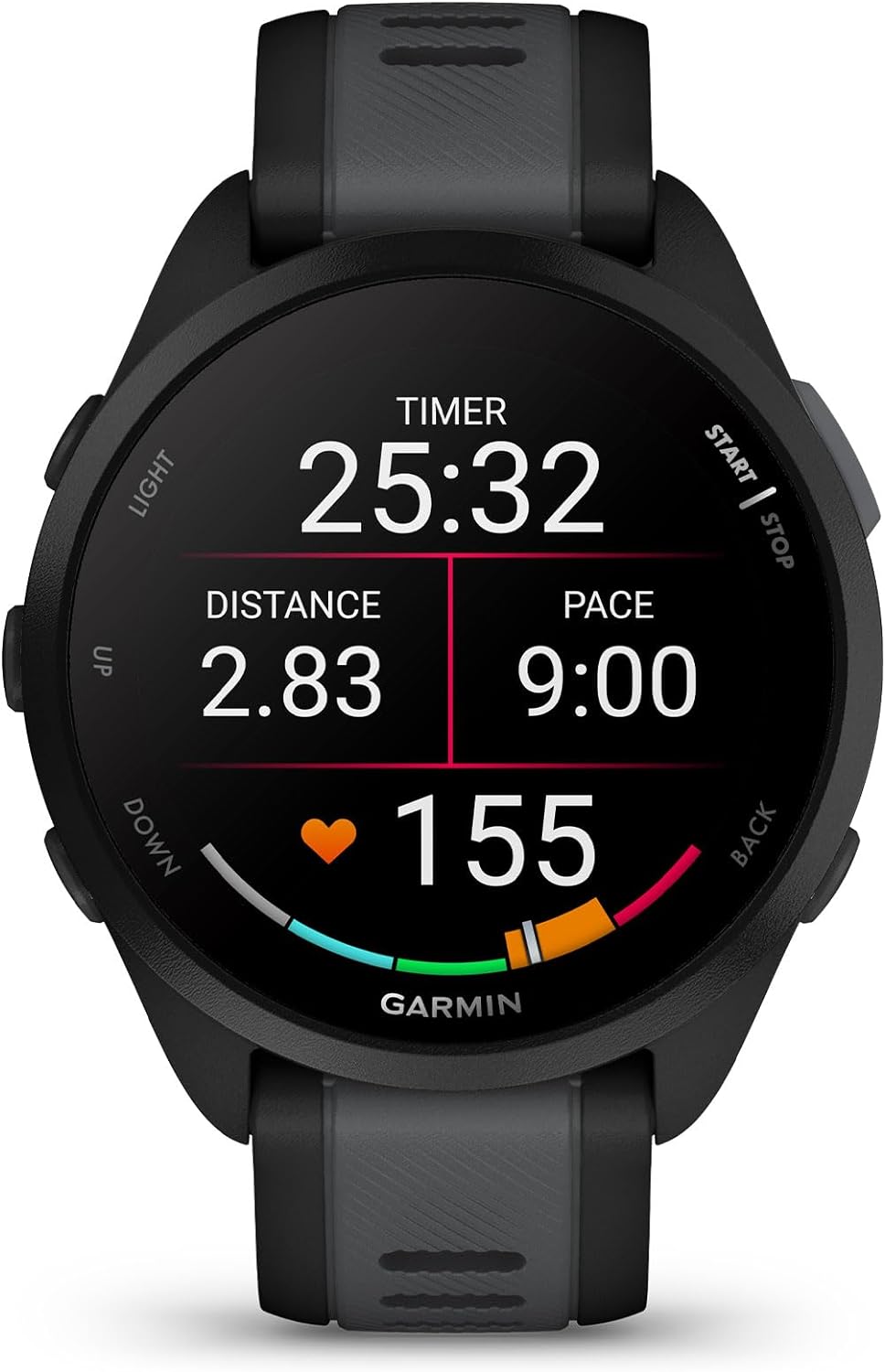
A GPS running watch is, at its simplest, a wristband computer that uses satellite signals to track where you run, how fast, and for how long — then layers in your heart rate, pace, and increasingly, a pile of coaching metrics that can either sharpen your training or overwhelm you completely. If you’re new to the category, the price range alone is disorienting: you can spend $200 on a capable beginner’s watch or $700 on something that looks like mission control. What actually separates them isn’t always obvious from the marketing. This guide cuts through that. Whether you’re prepping for your first half-marathon and want to know if a $200 watch is “enough,” or you’re a competitive age-grouper who suspects your current watch is leaving performance data on the table, here’s how to think about the decision — with specific models, honest tradeoffs, and a clear “if X, then Y” framework to close on.
| EDITOR'S PICKGoogle Pixel Watch 4 (41mm) - A… | Mid-tierCOROS PACE 3 GPS Sport Watch -… | Budget pickGarmin Forerunner 55 | |
|---|---|---|---|
| Battery life | 30-Hour | 17-Day | Up to 2 weeks |
| Case size | 41mm | — | — |
| GPS | — | Accurate GPS | — |
| Heart rate monitor | ✓ | ✓ | — |
| Sleep tracking | ✓ | ✓ | — |
| Navigation | — | ✓ | — |
| Price | $289.99 | $199.00 | $149.99 |
| See on Amazon → | See on Amazon → | See on Amazon → |
What the Spec Sheet Is Actually Telling You (and What to Ignore)
GPS watches market themselves on a lot of numbers. Battery life in hours, GPS accuracy in meters, “training load” scores, VO2max estimates, HRV (heart rate variability — a measure of recovery readiness derived from the tiny fluctuations between heartbeats), and recovery advisors that tell you whether today is a “go hard” or “go easy” day. The gap between a $200 and a $700 watch mostly comes down to four real differentiators:
1. GPS chip quality and multi-band support. Older and budget watches use single-frequency GPS, which loses accuracy in urban canyons (tall buildings) and dense tree cover. Modern mid-to-premium watches use dual-frequency or multi-band GPS — pulling signals from multiple satellite constellations (GPS, GLONASS, Galileo, etc.) simultaneously. DC Rainmaker’s exhaustive GPS accuracy comparisons, published across multiple watch reviews on dcrainmaker.com, consistently show multi-band watches outperforming single-band models by a meaningful margin in challenging environments. For track workouts or a flat road marathon, single-band is usually fine. For trail racing or city training with lots of turns and buildings, multi-band matters.
2. Optical heart rate accuracy (and its limits). Every watch in this guide uses a wrist-worn optical sensor that shines light into your skin and reads the pulse. The technology has improved dramatically, but it still lags about 5–10 seconds behind actual effort changes, and it can misread during intense intervals when wrist movement is high. Wirecutter’s GPS watch analysis notes that wrist-based HR is most reliable at steady-state paces and least reliable during hard interval sessions — exactly when accuracy matters most. If your training is interval-heavy, budgeting for a chest strap HR monitor as a pairing option is worth considering regardless of which watch you buy.
3. Training load and recovery metrics. This is where watches diverge sharply in philosophy. Garmin uses its own “Training Readiness” and “Body Battery” systems. COROS uses a simpler training load framework. Polar’s approach centers on their long-standing “Training Load Pro” and “Nightly Recharge” tools. None of these systems is perfectly accurate — they’re algorithmic estimates built on HR data and activity logs, not lab measurements. But over weeks and months, the patterns they surface (are you consistently overreaching? Are your easy runs too hard?) are genuinely useful. Runner’s World’s GPS watch coverage consistently flags that the value of these metrics compounds over time, once a watch has learned your baseline.
4. Battery life and use-case fit. A watch rated for 24 hours of GPS life is meaningless if you’re a trail ultrarunner doing 30-hour efforts. A watch rated for 100+ hours in battery-saver mode might sacrifice real-time pace accuracy to get there. Match battery to your longest event, with margin.
The Three Buyer Profiles — and Which Watch Fits Each
Profile 1: The Structured Half-Marathon Builder ($150–$250)
You’re running 30–45 miles per week, following a plan, and doing a mix of easy runs, tempo work, and long runs. You want pace, distance, and heart rate zones — but you don’t need your watch to coach you. You want reliability over feature depth.
The pick: Garmin Forerunner 255 (~$250 at retail)
The Forerunner 255 sits at the sweet spot of this category. It offers multi-band GPS in its Music variant, solid optical heart rate performance, and Garmin’s full suite of training metrics — including VO2max tracking and training status — without the complexity of Garmin’s flagship lineup. Battery life is rated at up to 30 hours in standard GPS mode, which comfortably covers any half or marathon with room to spare.
Owners on aggregated reviews across platforms consistently cite the Forerunner 255’s accuracy-to-price ratio as its defining strength. The tradeoff: the interface and Garmin Connect app have a learning curve. Wirecutter’s GPS watch recommendations (current as of early 2026) include the Forerunner 255 as a top pick in the mid-range tier for this exact buyer.
Runner-up: COROS Pace 3 (~$229)
The COROS Pace 3 is lighter and has a simpler software experience than the Forerunner 255, and its battery life is exceptional for the price — rated at 38 hours in full GPS mode. The tradeoff is a shallower training metrics ecosystem and fewer third-party app integrations. If you use Strava as your primary training log and don’t need deep analytics, the Pace 3 is legitimately compelling. DC Rainmaker’s COROS Pace 3 review on dcrainmaker.com praises its GPS accuracy and flags its metrics ecosystem as the main reason to choose Garmin instead.
Profile 2: The Competitive Age-Grouper Targeting a Marathon PR ($350–$600)
You have a multi-shoe rotation. You track your training blocks. You know what “threshold pace” means and you’ve looked up your lactate threshold at some point. You want a watch that can handle structured workouts, give you reliable race-day data, and surface recovery signals you’ll actually act on.
The pick: Garmin Forerunner 965 (~$599)
The Forerunner 965 is the current benchmark for dedicated running watches in this tier. It includes Garmin’s Running Dynamics (cadence, vertical oscillation, ground contact time — metrics that describe your running form numerically), multi-band GPS, advanced HRV tracking, a training readiness score, and an AMOLED display that’s significantly easier to read than earlier LCD Garmin screens. Battery life is rated at up to 31 hours in GPS mode, or 110 hours in battery-saver mode — enough for any ultramarathon you’re likely to attempt.
Across aggregated owner reviews and coverage at Runner’s World and Outside Online, the Forerunner 965 earns consistent praise for the depth and reliability of its training load data over long training cycles. The price is real, and the tradeoffs are worth naming: it’s heavier than the Pace 3 (52g vs. 39g per published specs), the feature set has a steep onboarding curve, and if you’re only going to use 30% of its capabilities, you might be overpaying.
Strong alternative: Polar Vantage V3 (~$599)
Polar’s approach is different from Garmin’s in a way that matters for this buyer. Polar’s “Training Load Pro” tool separates cardiovascular, muscular, and perceived load — a more nuanced framework than Garmin’s single training load score. iRunFar’s coverage of the Vantage V3 notes it as a particularly strong option for runners who are serious about recovery monitoring and willing to spend time in Polar’s ecosystem. The tradeoff: Polar’s app and third-party integrations lag behind Garmin Connect’s breadth.
Profile 3: The Sub-Elite or Ultra-Distance Athlete ($600–$700+)
You’re targeting podiums, running 70+ miles per week, or spending 20+ hours a week on your feet. You need GPS accuracy in every terrain type, multi-day battery life, robust offline mapping, and metrics granular enough to inform real coaching conversations.
The pick: COROS Vertix 2S (~$699)
The Vertix 2S is purpose-built for this buyer. Published specs put GPS battery life at up to 140 hours in full GPS mode — a number no other watch in this price class approaches. It includes dual-frequency GPS, topographic maps onboard, and COROS’s “EvoLab” training metrics, which include a lactate threshold estimate and running economy scores derived from your training history.
iRunFar’s trail and ultra watch coverage consistently ranks the Vertix 2S among the top choices for ultra-distance athletes specifically because of its battery ceiling and mapping capabilities. The honest tradeoff: COROS’s training metrics ecosystem, while improving, is still less mature than Garmin’s for runners whose coaches use third-party platforms built around Garmin Connect data. If your coach is using TrainingPeaks with Garmin integrations, check compatibility before committing.
By the Numbers: Quick Comparison
| Watch | Price | GPS Battery | Multi-Band GPS | Weight |
|---|---|---|---|---|
| COROS Pace 3 | ~$229 | 38 hrs | Yes | 39g |
| Garmin Forerunner 255 | ~$250 | 30 hrs | Yes (Music) | 49g |
| Garmin Forerunner 965 | ~$599 | 31 hrs | Yes | 52g |
| Polar Vantage V3 | ~$599 | 43 hrs | Yes | 54g |
| COROS Vertix 2S | ~$699 | 140 hrs | Yes | 89g |
Specs per manufacturer published data, May 2026.
The Decision Framework: If X, Then Y
This is where most buying guides get vague. Here’s the explicit version:
If you’re training for your first half or second marathon and your longest run will never exceed 4 hours: The Garmin Forerunner 255 or COROS Pace 3 is the right ceiling. Don’t spend $600 yet. Get reps with the data before you invest in more of it.
If you’re targeting a marathon PR and already acting on heart rate zone data in your current training: Step up to the Forerunner 965 or Polar Vantage V3. The training load depth will inform decisions you’re already making — it just gives you better signal.
If you’re running trails, ultras, or events longer than 6 hours: The COROS Vertix 2S isn’t a splurge; it’s a spec requirement. Battery life and mapping aren’t luxury features at that distance — they’re safety features.
If you’re currently on a basic GPS watch and considering your first upgrade: The single most impactful upgrade isn’t the watch model — it’s pairing any watch with a chest-strap heart rate monitor for interval sessions. Wirecutter and DC Rainmaker both flag this consistently: wrist optical HR improves in steady state, but chest straps remain the accuracy standard for high-intensity work.
The watch market at mid-2026 is genuinely competitive across all three tiers. The differences between a $599 Garmin and a $599 Polar are philosophical more than technical — it comes down to which ecosystem you’ll actually live in. Pick the one your training plan, coach, and current data habits align with, not the one with the longest spec sheet. The best watch is the one whose data you’ll use.