A GPS running watch is exactly what it sounds like: a wristwatch with a built-in GPS chip — the same satellite-based technology your phone uses for navigation — that tracks where you run, how fast you’re going, and how far you’ve gone, all without needing your phone in your pocket. The better models layer on continuous heart rate monitoring (a sensor on the watch’s underside that reads your pulse around the clock), sleep tracking, and training metrics that help you understand whether your body is absorbing the work you’re putting in. If you’ve outgrown tracking runs on your phone or you’re ready to move from a basic fitness tracker to something built specifically for running, the $150–$250 price band is where the real decisions live. This article breaks down five watches in that range — the Garmin Forerunner 55, Forerunner 165, COROS PACE 3, COROS PACE 4, and Google Pixel Watch 4 — so you can match the right tool to the way you actually train.
| EDITOR'S PICKGoogle Pixel Watch 4 (41mm) - A… | Mid-tierGarmin Forerunner 55 | Budget pickGarmin Forerunner 165 | |
|---|---|---|---|
| Display | — | — | AMOLED |
| Battery Life | 30-Hour | 2 Weeks | — |
| Heart Rate | ✓ | — | — |
| Compatibility | Android | — | — |
| Suggested Workouts | — | ✓ | — |
| Price | $289.99 | $149.99 | $129.00 |
| See on Amazon → | See on Amazon → | See on Amazon → |
The Contenders at a Glance
Before getting into the tradeoffs, here’s the spec-sheet reality that shapes every comparison below. Battery figures are manufacturer-rated at standard GPS mode. Real-world use — especially with continuous heart rate, notifications, and multi-band GPS active — will compress those numbers. DC Rainmaker’s in-depth reviews, which are among the most methodologically rigorous independent watch evaluations published, consistently find Garmin and COROS land within roughly 10–15 percent of their rated GPS figures, while the Pixel Watch 4 runs closer to its rated ceiling when GPS is on continuously.
| Watch | GPS Battery | Weight | Screen Type | Dual-Band GPS |
|---|---|---|---|---|
| Forerunner 55 | ~28 hrs | ~37 g | MIP | No |
| Forerunner 165 | ~19 hrs | ~47 g | AMOLED | No |
| COROS PACE 3 | ~38 hrs | ~30 g | MIP | Yes |
| COROS PACE 4 | ~38 hrs | ~30 g | AMOLED option | Yes |
| Pixel Watch 4 | ~24 hrs | ~37 g | AMOLED | Yes |
Garmin Forerunner 55 vs. Forerunner 165: The Upgrade Question
Forerunner 55 — The Reliable Entry Point
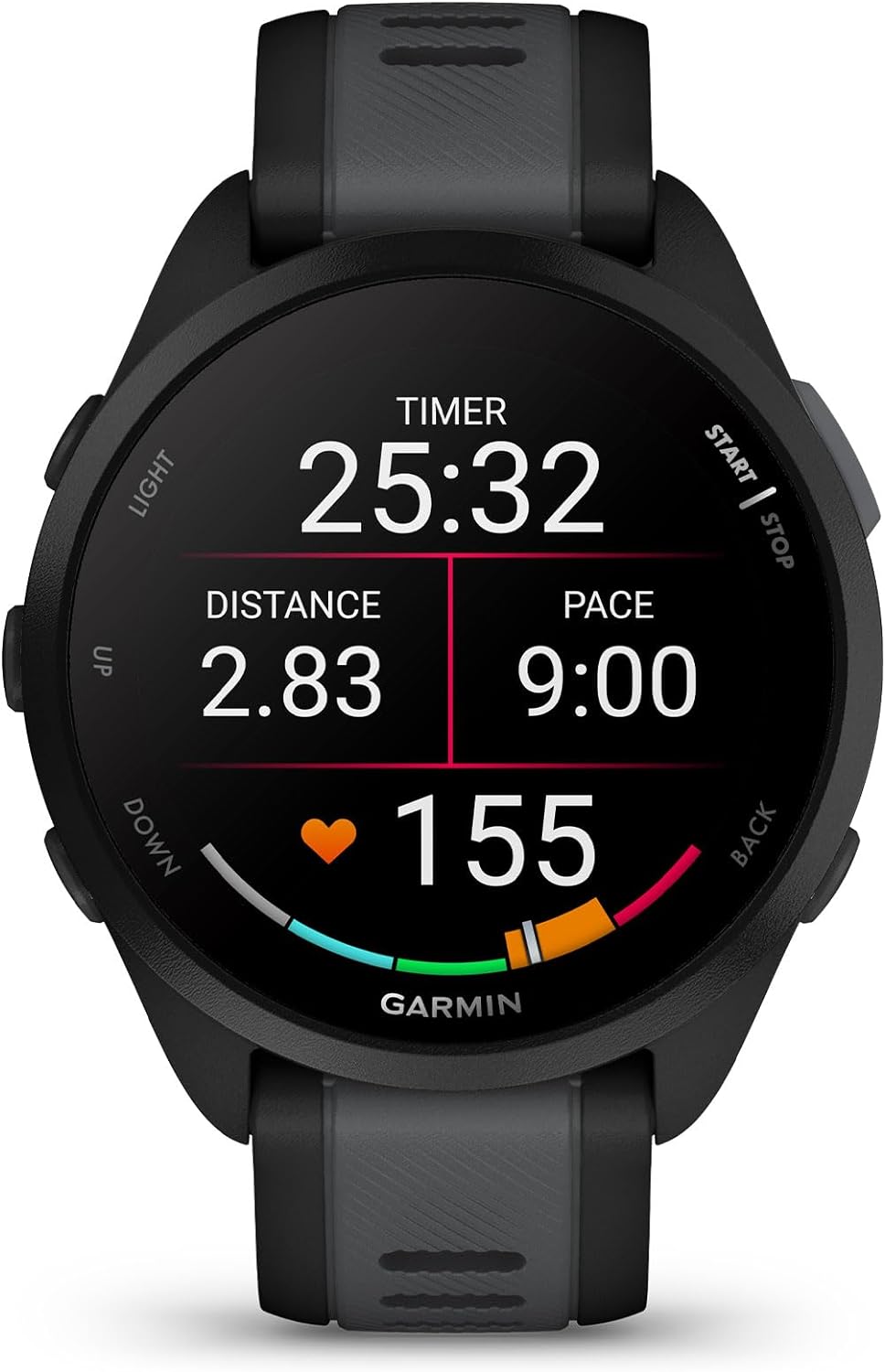
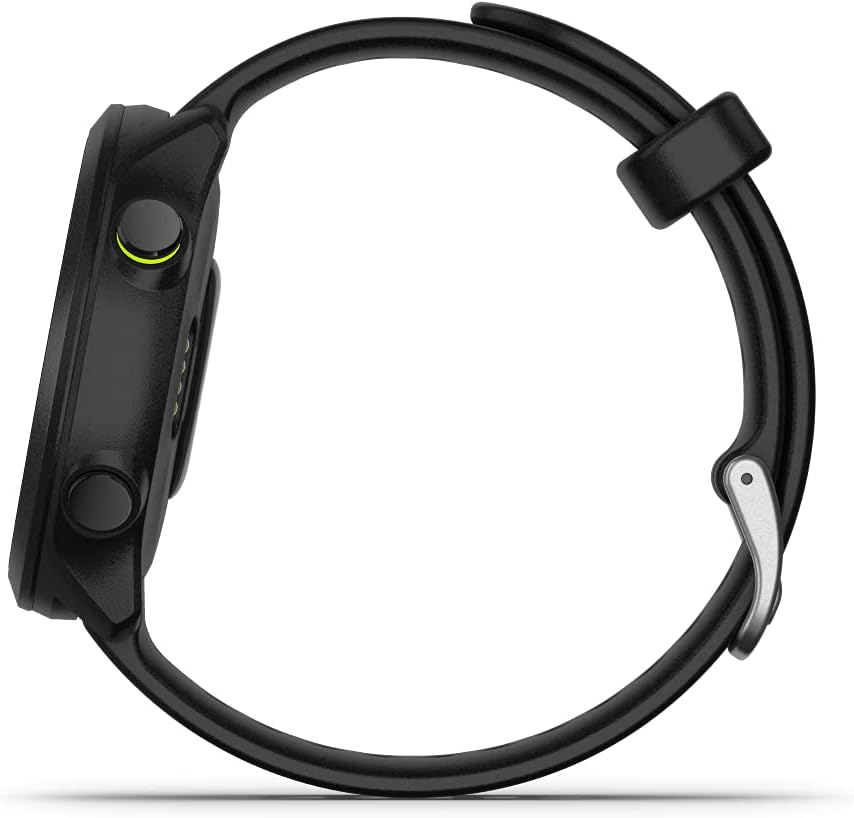
The Forerunner 55 is the entry point that earns its reputation honestly. RunRepeat’s aggregated owner review data for the Garmin Forerunner 55 consistently places it among the highest-satisfaction GPS watches in its price tier. Reviewers repeatedly call out the 24/7 heart rate monitoring and the roughly one-week battery life in smartwatch mode as standout features for the price. Owners who switched from Polar and Fitbit devices describe the 55 as a meaningful step up in running-specific data — pace alerts, structured workout support, and Garmin’s training load metrics are things those platforms don’t match at this price point. The recurring criticism in those same aggregated reviews is that the watch runs large for smaller wrists; if you’re buying for someone with a narrow wrist, try it on before committing.
Garmin
$129.00
In stock on Amazon
Check price on AmazonForerunner 165 — The Screen Upgrade Argument
The Forerunner 165 answers a specific question: what do I get for roughly $60 more? The answer is primarily the AMOLED screen — a display technology (the same type used in most flagship smartphones) that produces vivid color and is dramatically easier to read in bright sunlight compared to the older MIP (memory-in-pixel) display on the 55. According to DC Rainmaker’s in-depth review of the Garmin Forerunner 165, screen brightness is the defining upgrade that separates the two models in everyday use. Runner’s World’s Best GPS Running Watches coverage corroborates this finding, noting the 165’s display as one of the better screens available in the sub-$250 tier. Owners also report 13-day battery life in smartwatch mode when notifications are disabled, which is competitive for an AMOLED watch.
The decision frame:
- If battery life and cost are your primary constraints, and you don’t spend a lot of time glancing at your watch mid-run, the Forerunner 55 does the job cleanly.
- If you run in variable lighting — early mornings, shaded trails, bright midday — or you find yourself squinting at watch screens, the Forerunner 165’s AMOLED display is a genuine quality-of-life upgrade, not just a spec-sheet line item.
Garmin
$149.99
In stock on Amazon
Check price on AmazonCOROS PACE 3 and PACE 4: The Lightweight Challenger Case
COROS has spent the last several years building a reputation for watches that feel designed by runners rather than by a marketing team optimizing for checklist features. The COROS PACE 3 and PACE 4 are where that philosophy shows most clearly.
COROS PACE 3 — Dual-Band GPS at a Budget-Friendly Price
The weight difference between COROS and Garmin is real and noticeable. At 30 grams, both PACE models are meaningfully lighter than any Garmin in this comparison — that’s roughly the difference between feeling the watch and not feeling it during a long run. Podium Runner’s review of the COROS PACE 4 notes that weight is one of the most common reasons runners switch brands at this price tier. DC Rainmaker’s in-depth review of the COROS PACE 3 emphasizes that dual-band GPS — which uses two satellite frequencies simultaneously to produce more accurate positioning, especially in urban canyons or dense tree cover — is a feature Garmin charges significantly more to access, making the PACE 3 a strong value proposition for runners who train in GPS-noisy environments.
Runner’s World’s GPS watch coverage across multiple review cycles corroborates the dual-band GPS value argument, consistently noting that COROS delivers the feature at a price point well below comparable Garmin hardware.
The COROS app is polarizing. Owners who come from Garmin Connect describe it as simpler — some find that refreshing, others miss the depth of Garmin’s training ecosystem, particularly structured coaching plans and third-party app integrations. If your training log lives in Strava or TrainingPeaks, the distinction matters less; COROS syncs cleanly to both platforms.
Garmin
$129.00
In stock on Amazon
Check price on AmazonCOROS PACE 4 — The AMOLED Step-Up
The PACE 4 adds an AMOLED display option and modest software refinements over the PACE 3. Podium Runner’s COROS PACE 4 review positions it as the better choice for runners who want the lightweight COROS experience without sacrificing screen readability — particularly useful for athletes who train early in the morning or after dark. The core GPS performance, battery life, and weight remain essentially identical to the PACE 3.
The decision frame:
- If you’re a weight-conscious runner — racing half-marathons or marathons and sensitive to what’s on your wrist — the PACE 3 or PACE 4 at this price point is hard to argue against.
- If you’re embedded in the Garmin ecosystem (structured coaching plans, synced devices, third-party app integrations), the switching cost is real. Budget time to re-learn the app and rebuild any custom workouts.
- PACE 4 vs. PACE 3: if the screen matters to you, it’s worth the step up; if you’re indifferent to display type, the PACE 3 remains a strong buy.
Garmin
$149.99
In stock on Amazon
Check price on AmazonGoogle Pixel Watch 4: The Honest Outlier
When a Smartwatch Is Enough — and When It Isn’t
The Pixel Watch 4 belongs in this comparison only with a clear-eyed disclaimer: it is not primarily a running watch. It is a lifestyle smartwatch with solid running features, and that distinction should drive your decision.
According to DC Rainmaker’s in-depth review of the Google Pixel Watch 4, the watch excels at AFib detection (atrial fibrillation — an irregular heart rhythm that a growing number of wearables can now flag for follow-up with a doctor), seamless pairing with Pixel phones, and a premium AMOLED display experience. Reviewers consistently position it as the watch to buy if you want one device that handles fitness tracking and smartwatch duties — notifications, contactless payments, and health monitoring — without compromise.
The tradeoffs are significant for serious runners. Battery life in GPS mode runs 24 hours or less at the rated ceiling, and real-world smartwatch use lands around 4–5 days before charging is required. That’s enough for most training weeks, but it means charging every few days rather than every week or two, as you’d expect from a dedicated running watch. The running-specific metric depth — recovery tracking, VO2 max trend analysis, structured workout support — is thinner than what Garmin or COROS offer at comparable prices, as noted in DC Rainmaker’s Pixel Watch 4 in-depth review. And critically, the Pixel Watch 4’s value proposition is tightly coupled to the Pixel phone ecosystem; if you’re on iPhone or a non-Pixel Android device, you lose a meaningful portion of what makes the watch compelling.
The decision frame:
- If you run three to four times per week, prioritize health tracking and AFib detection, and want a watch that looks appropriate in a work meeting, the Pixel Watch 4 is a legitimate choice.
- If you’re training for a half-marathon with structured plans, tempo workouts, and weekly mileage targets above 30 miles, a dedicated running watch will serve you better.

$289.99
In stock on Amazon
Check price on AmazonFrequently Asked Questions
Does the Forerunner 55 work for first-time half-marathon training, or is it too basic?
It works well. The Forerunner 55 supports structured interval workouts, pace alerts, and a virtual pacer — all of which are useful tools for half-marathon training. RunRepeat’s aggregated owner reviews describe it as more than sufficient for building to a first half. The main limitations are the absence of dual-band GPS and a less vivid display; neither is a dealbreaker for a first race build.
Is the AMOLED screen on the Forerunner 165 worth the extra cost over the Forerunner 55?
For most runners, yes — especially if you train in bright sunlight or low light. DC Rainmaker’s Forerunner 165 in-depth review and Runner’s World’s GPS watch coverage both describe the display as a meaningful quality-of-life improvement over older MIP screens. If you rarely look at your watch mid-run and primarily review data post-run on your phone, the upgrade is less compelling.
How does COROS battery life hold up with GPS running on versus just daily wear?
COROS publishes approximately 38 hours of GPS battery life for the PACE 3 and PACE 4 in standard GPS mode — enough for an ultramarathon, not just a weekend long run. In daily-wear smartwatch mode with GPS off and continuous heart rate active, COROS rates it at roughly 17 days. DC Rainmaker’s in-depth review of the COROS PACE 3 found real-world GPS figures land close to rated specs, making it one of the stronger battery performers in the sub-$250 tier.
Can the Google Pixel Watch 4 replace a dedicated running watch for casual runners?
For casual runners — say, two to three runs per week, no structured training plan, primarily tracking distance and heart rate — yes, the Pixel Watch 4 is capable. DC Rainmaker’s Google Pixel Watch 4 in-depth review confirms GPS accuracy is solid and the health-tracking suite is comprehensive. The caveat: battery life requires more frequent charging than dedicated running watches, and the running metric depth won’t satisfy anyone who wants recovery scores or detailed training load analysis.
Do any of these watches require a phone nearby to track GPS accurately?
No — all five watches have onboard GPS chips and can track your run independently, with no phone required. Your phone is used to sync data and configure the watch, but it doesn’t need to be present during a run. This is one of the key distinctions between a dedicated GPS running watch and a basic fitness tracker, which often depends on your phone’s GPS signal for route tracking.
The Bottom Line
If you’re building your first real training setup and want a watch that will grow with you through an initial half-marathon build: the Forerunner 55 covers the fundamentals without overcomplicating the decision. RunRepeat’s aggregated owner data backs up its reputation as a high-satisfaction entry point.
If the screen matters and you’re staying in the Garmin ecosystem: the Forerunner 165 is the step up that owners and reviewers at DC Rainmaker and Runner’s World consistently call worth it, particularly around the $200 mark.
If you’re weight-conscious, want dual-band GPS accuracy without paying a premium for it, and are open to a platform switch: the COROS PACE 3 or PACE 4 is the argument that Podium Runner and DC Rainmaker both validate — dual-band GPS at a price Garmin simply doesn’t match in this tier.
If you want a watch that pulls double duty as a lifestyle smartwatch, you’re a Pixel phone user, and running is one part of a broader health-tracking goal: the Pixel Watch 4 is the honest choice — just go in knowing it’s a smartwatch with running features, not the reverse.