If you’ve ever searched for a trail shoe that also works on pavement, you already know the frustration: most dedicated trail shoes are stiff, aggressive-lugged designs that feel like hiking boots on asphalt, while most road shoes fall apart the moment you hit gravel. The four shoes in this article — the New Balance 410 V8, the New Balance 410 V9, the ASICS Gel-Venture 10, and the ASICS Gel-Venture 11 — live in a different lane. They’re max-stack, meaning they carry a thick midsole for cushioning (extra foam between your foot and the ground), yet they’re priced and built for everyday mixed-use: light trails, neighborhood roads, hiking, yard work, and everything in between. If you’re a road runner who wants one rugged shoe to cover a lot of bases without spending $200 or more, this comparison is for you. We’ll show you exactly where each shoe wins, where it falls short, and which one earns the buy based on your specific situation.
| EDITOR'S PICKASICS Women's Gel-Venture 11 Tr… | Mid-tierASICS Women's Gel-Venture 10 Ru… | Budget pickNew Balance Men's 410 V8 Trail… | |
|---|---|---|---|
| Model | Gel-Venture 11 | Gel-Venture 10 | 410 V8 |
| Gender | Women's | Women's | Men's |
| Color | Gravel/Lilac | Black/Light Ube | Black/Cayenne/Shadow |
| Size | 9 | 7.5 | 10.5 |
| Terrain | Trail | Running | Trail |
| Price | $69.95 | $54.95 | $49.86 |
| See on Amazon → | See on Amazon → | See on Amazon → |
Who Actually Buys These Shoes — and Why It Changes the Comparison
Before diving into specs, it’s worth being honest about the buyer pool here, because it matters for the decision frame. According to aggregated buyer review data compiled by RunRepeat (runrepeat.com) covering the New Balance 410 and ASICS Gel-Venture series, the majority of people choosing these shoes are not dedicated trail runners training for a mountain ultramarathon. They’re runners who want a single versatile shoe that can handle a mix of terrain without demanding specialized care. Reviewers consistently mention using these shoes for hiking, beach walking, biking commutes, forest paths, yard work, and casual running — often in the same week.
That framing changes what “best” means. In this segment, traction and durability beat weight and energy return every time. You’re not trying to shave seconds off a tempo run. You’re trying to find a shoe that doesn’t blow out at 400 miles, doesn’t slip on wet roots, and doesn’t punish your knees on long pavement stretches. Keep that in mind as you read through the tradeoffs below.
New Balance 410 V8 vs. V9: What Actually Changed
The New Balance 410 has been a sleeper hit in the budget trail category for years. The V8 is the shoe that built the reputation; the V9 is the update that refined — and slightly repositioned — it.
The V8: The Durability Benchmark
New
$49.86
In stock on Amazon
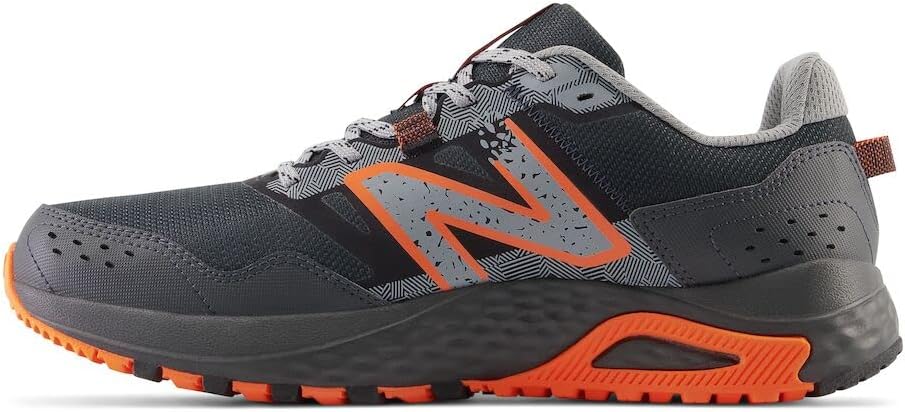
Check price on AmazonThe New Balance 410 V8 is the durability standout in this comparison, and it’s not particularly close. Owner feedback aggregated by RunRepeat (runrepeat.com) includes at least one documented account of over 1,000 miles logged in approximately four months at around 10 miles per day — an exceptional data point that changes a purchase decision. At a price point well under $100, crossing 1,000 miles without structural breakdown places the V8 into a cost-per-mile category that most shoes at twice the price cannot match.
Owners consistently report the V8 holds up through repeated wet-weather runs, gravel, compressed dirt, and light pavement without the outsole chunking or the upper delaminating early. The fit skews slightly roomy in the toebox, which most reviewers treat as a positive — particularly for longer distances where feet swell. New Balance’s wide-width availability is a consistently cited buying reason, especially from runners who’ve been burned by narrow-fitting trail shoes in the past.
What you give up with the V8: it’s not a shoe that rewards pace. The cushioning is functional but not plush. Energy return is minimal. If you’re running sub-9:00 miles and want the ground to push back, this isn’t your shoe. But if your goal is logging miles on mixed terrain without babying your footwear, the V8 delivers in a way few shoes at its price point can match.
According to New Balance’s official product specifications for the 410 V8, the shoe uses a standard EVA midsole compound and a multidirectional rubber lug outsole rated for mixed-surface use. Wide (2E) and extra-wide (4E) fits are offered across most colorways.
New
$49.86
In stock on Amazon
Check price on AmazonThe V9: Fresh Foam Enters the Picture
New
$49.86
In stock on Amazon
Check price on AmazonThe V9 makes two meaningful changes: it introduces Fresh Foam cushioning — New Balance’s proprietary foam compound, engineered to be softer and more responsive than standard EVA — and upgrades to a more aggressive multidirectional lug pattern on the outsole. Both changes are genuine improvements, but they come with a subtle audience shift.
According to New Balance’s official product specifications for the 410 V9, the Fresh Foam midsole is the same foam platform used across New Balance’s broader running lineup, bringing the V9 noticeably closer to road-shoe comfort levels while retaining trail-capable outsole geometry. The more aggressive lug pattern reads as an upgrade on dirt and mud; on pavement, it’s neutral at worst.
The V9 is a better shoe for someone who actually runs trails regularly, values a more cushioned underfoot feel, and wants improved grip on technical terrain. The tradeoff: long-term durability data on the V9 is still accumulating. The V8 has a proven 1,000-mile track record across multiple documented owner accounts gathered by RunRepeat (runrepeat.com); the V9 is newer. If durability over an 18-to-24-month heavy-use window is your primary concern, the V8 remains the safer bet based on current evidence.
New
$49.86
In stock on Amazon
Check price on AmazonNB 410 V8 vs. V9: Side-by-Side
| Feature | NB 410 V8 | NB 410 V9 |
|---|---|---|
| Cushioning platform | Standard EVA | Fresh Foam |
| Outsole lug aggression | Moderate | High |
| Wide-width available | Yes (2E, 4E) | Yes (2E, 4E) |
| Documented 1,000-mi durability | Yes (multiple accounts) | Pending |
| Best for | High-mileage durability seekers | Active trail runners wanting modern ride |
ASICS Gel-Venture 10 vs. 11: Versatility vs. a Durability Flag
The Gel-Venture line is ASICS’s answer to the same question: how do you build a shoe that a normal active person can buy once and use everywhere? The answer, across both versions, is a GEL cushioning insert in the heel — a silicone-based pad that absorbs impact, functioning like a shock absorber under your heel — combined with a grippy enough outsole for light trails and a simple, comfortable upper that works for wide feet and long days alike.
The Gel-Venture 10: The Versatility Champion
New
$49.86
In stock on Amazon
Check price on AmazonIf buyer feedback is the data source, the Gel-Venture 10 is one of the most contextually versatile shoes in this price tier. According to aggregated owner reviews compiled by RunRepeat (runrepeat.com), buyers report wearing the Gel-Venture 10 for trail running, hiking, beach walking, forest paths, yard work, and biking commutes — often without any complaint about premature wear or comfort degradation across those uses. That’s a genuinely wide use case, and it speaks to a shoe that doesn’t demand a single specific environment to perform well.
According to ASICS’s official product specifications for the Gel-Venture 10, the shoe pairs an AMPLIFOAM midsole — a lightweight foam formulation ASICS uses across its entry and mid-tier running lineup — with the GEL heel insert. That combination produces a ride that’s softer than entry-level EVA but not so pillowy that it becomes unstable on uneven ground. Fit-wise, reviewers note the Gel-Venture 10 runs close to true to size, with a standard width that works for average to slightly wide feet, though buyers on the wider end sometimes opt up a half size for longer efforts.
Runner’s World (runnersworld.com), in its ongoing coverage of budget trail shoe options for mixed-use runners, has noted the Gel-Venture line’s consistent positioning as a starter trail shoe that earns repeat purchases specifically because of its multi-context durability — a rare quality in the under-$80 tier.
New
$49.86
In stock on Amazon
Check price on AmazonThe Gel-Venture 11: Better Specs, One Honest Concern
New
$49.86
In stock on Amazon
Check price on AmazonThe Gel-Venture 11 refines the formula with updated materials and a slightly more modern outsole geometry. On paper and in early reviews, the ride quality improvements over the 10 are real.
However, there is a durability flag worth naming directly. According to ASICS’s official product specifications for the Gel-Venture 11, the shoe introduces revised foam density in the AMPLIFOAM midsole and updated rubber coverage on the outsole. Early buyer accounts aggregated by RunRepeat (runrepeat.com) include at least one reviewer raising wear concerns with the Gel-Venture 11 that were not present with the 10 — specifically around outsole longevity under sustained high-mileage use. The pattern is not widespread enough to call a systemic defect, but it is worth naming.
Runner’s World (runnersworld.com), in its budget trail shoe durability reporting, has observed that outsole and midsole longevity in entry-tier trail shoes often varies meaningfully between model generations as manufacturers adjust foam compounds and rubber blends — a pattern consistent with what early Gel-Venture 11 reviewers are describing.
If you’re buying for casual mixed-use at moderate mileage — under 500 miles per year — the Gel-Venture 11 is a reasonable bet. If you’re logging significant weekly mileage and need a shoe to survive 12 to 18 months without structural concern, the Gel-Venture 10 or the NB 410 V8 is the more defensible choice based on current evidence.
New
$49.86
In stock on Amazon
Check price on AmazonGel-Venture 10 vs. 11: Side-by-Side
| Feature | Gel-Venture 10 | Gel-Venture 11 |
|---|---|---|
| Midsole foam | AMPLIFOAM | Updated AMPLIFOAM |
| GEL heel insert | Yes | Yes |
| Wide-width available | Limited | Limited |
| Documented durability concern | None flagged | Early accounts noted |
| Best for | Multi-use versatility, moderate-to-high mileage | Light use, buyers wanting newest version |
The Decision Frame: Which Shoe for Which Runner
Here’s where the analysis pays off. Based on the pattern across all four shoes, the decision almost always comes down to three variables: intended mileage, terrain mix, and foot width.
If your primary concern is raw durability over high mileage: The New Balance 410 V8 is the clear answer. No shoe in this group has documented evidence of 1,000-plus mile longevity at 10 miles per day, as recorded in buyer reviews aggregated by RunRepeat (runrepeat.com). If you run a lot and don’t want to think about shoe replacement every few months, this is the pick.
If you want trail grip to actually improve and you run on real dirt: The New Balance 410 V9’s Fresh Foam midsole and more aggressive lug pattern, as detailed in New Balance’s official product specifications for the 410 V9, make it the better active-trail running shoe. It’s a genuine upgrade for someone who runs trails two or more days per week and wants a more modern ride.
If your use case is genuinely multi-directional — trails, pavement, hiking, errands: The ASICS Gel-Venture 10 is the most versatile shoe in this group based on aggregated owner feedback from RunRepeat (runrepeat.com). The GEL heel cushioning makes it comfortable across long days on varied surfaces in a way that purely trail-focused outsoles don’t always allow.
If you’re buying for light, occasional use and want the newest version: The ASICS Gel-Venture 11 offers real ride improvements but carries an honest durability asterisk based on early buyer feedback. Buy it for moderate use; don’t buy it if you’re expecting 700-plus miles of longevity.
On wide sizing: New Balance wins this category outright. The 410 V8 and V9 both offer 2E and 4E wide-width options per New Balance’s official product specifications, which is a meaningful differentiator for runners who’ve had fit problems with narrower trail shoes. ASICS’s standard Gel-Venture sizing works for most feet, but wide-width availability is limited compared to New Balance.
Frequently Asked Questions
How long do the New Balance 410 trail shoes last under high-mileage use? The V8 has the strongest documented case for longevity in this group. Owner reviews aggregated by RunRepeat (runrepeat.com) include at least one account of over 1,000 miles in approximately four months at 10 miles per day with no structural breakdown. The V9 is newer and durability data is still accumulating, but its construction is similar and early reception is positive.
Are these shoes appropriate for hiking as well as running? Yes. All four shoes in this comparison handle light-to-moderate hiking comfortably. ASICS Gel-Venture 10 reviewers specifically mention forest hiking and long walking days as primary use cases, per RunRepeat (runrepeat.com) aggregated feedback. Neither the NB 410 nor the Gel-Venture series is built for technical scrambling, but for hiking on maintained paths, they perform well.
Do the ASICS Gel-Venture shoes run true to size? Based on aggregated buyer feedback from RunRepeat (runrepeat.com), the Gel-Venture 10 runs close to true to size for average-width feet. Buyers with wider feet sometimes size up half a size for comfort on longer efforts. The Gel-Venture 11 follows a similar sizing pattern based on early reviews.
What is the difference between the NB 410 V8 and V9? Per New Balance’s official product specifications, the V9 adds Fresh Foam cushioning — a softer, more responsive foam compared to the V8’s standard EVA — and a more aggressive lug pattern for improved trail traction. The V8 retains a simpler cushioning setup but has a longer, better-documented durability track record. Both offer wide-width sizing.
Can these trail shoes be worn comfortably for everyday walking? Yes — and this is the primary use case for a large share of buyers in this category, as reflected in the aggregated review data compiled by RunRepeat (runrepeat.com). The GEL heel cushioning in the ASICS line and the Fresh Foam in the NB 410 V9 both provide enough comfort for multi-hour walking. The NB 410 V8 is slightly firmer underfoot but still comfortable for everyday use. None of these shoes will feel out of place on a long errand day or a mixed walking-running commute.